Mastering the DTV Application in 2026
The Destination Thailand Visa (DTV) is the current gold standard for digital nomads in Chiang Mai. This comprehensive guide covers DTV financial requirements, employment verification, 180-day extensions, common rejection reasons, and step-by-step application process in 2026. With 5-year validity and low fees, the DTV is ideal for remote workers. However, 2026 has brought stricter scrutiny to applications, particularly regarding financial history, proof of remote work, and two entirely new nationwide document requirements.
To secure a DTV in 2026, you must show 500,000 THB (~$14,500 USD) in a personal bank account, seasoned for at least 90 days. You also need verifiable proof of remote work (contracts/salary slips) or enrollment in a "Soft Power" course like Muay Thai or Thai Cooking, with course-length expectations trending from six months toward nine. You cannot apply from within Thailand; you must be outside the country to use the official Thai e-Visa portal. You also now need proof of citizenship or permanent residence in your country of application, plus a police clearance certificate, and you generally need to apply from your home country rather than a convenient third country. See the full DTV visa guide for the country-by-country breakdown.
1. The Financial "Seasoning" Standard
The most common reason for DTV rejection in 2026 is "unverifiable funds." Immigration doesn't just verify that 500,000 THB exists in your account. They verify that the money is yours, has been yours, and will remain yours. A bank balance without history is a rejected application.
The 90-Day Seasoning Requirement
Immigration requires bank statements covering a minimum of 90 consecutive days before your application date. The balance must remain at or above 500,000 THB for the entire 90-day window. Even a single day dropping below this threshold can trigger rejection.
If 500,000 THB suddenly appears in your account 24 hours before you apply, the statements reveal the deposit date. Immigration flags this as "borrowed funds" and rejects the application immediately. The phrase in their system is "source of funds unclear" or "unverifiable balance."
Real scenario: An applicant had 300,000 THB saved. On day 88 of the 90-day window, he deposited 200,000 THB (from a family gift). His bank statement showed the deposit clearly. Immigration rejected the application because the seasoning period resets at the point of the new deposit. He had to wait another 90 days from the gift deposit date before reapplying.
Accepted vs. Rejected Account Types
Only personal savings or checking accounts in your individual name are accepted. Business accounts, joint accounts, and investment accounts are strictly rejected. Here is what does NOT work:
- Business accounts: Even if you are the sole proprietor. Immigration sees a business account as company funds, not personal funds.
- Joint accounts: Shared with spouse, partner, or family. Ownership is ambiguous.
- Investment accounts: Stocks, crypto wallets, bonds, or trading platforms. Too liquid risk in immigration's view.
- Fixed deposits (in Thailand): Locked funds. Immigration prefers liquid, accessible savings.
- Cryptocurrency: Explicitly rejected. No Thai bank recognises crypto holdings.
Bank Statement Documentation Strategy
Obtain official bank statements (or e-statements) from your bank covering the full 90 days. Printouts must show:
- Account holder's full name (exactly as on passport)
- Account number (full or last 4 digits)
- Bank name and branch
- Account type (Savings or Checking)
- Statement dates (e.g., January 1 to March 31)
- Opening and closing balance each month
- All deposits and withdrawals with dates and amounts
- Final balance (must be 500,000 THB or higher)
If your bank uses online banking (e-statements), print them directly from the bank's website in PDF format. Screenshots do not count. Screenshots are treated as unverified by immigration officers.
Chiang Mai Immigration Specific: Officers at Promenada sometimes request a letter from your bank (on letterhead) confirming account ownership and balance on the application date. Request this letter 7 days before your appointment. Some banks charge 100-200 THB for this service. Plan ahead.
Guru Tip: Create a spreadsheet showing the 90-day balance progression (date, opening balance, deposits, withdrawals, closing balance). Print this alongside your statements. It shows deliberate preparation and makes immigration officer's job easier. Officers process 10-15 applications per day; making their work faster improves approval odds.
2. Proving Your Category: Remote Work, Soft Power & Dependents
Immigration requires that you justify why Thailand granted you a 5-year visa. You must select one of three categories and provide evidence matching that category. You cannot claim multiple categories on the same application. Choose carefully.
Category 1: Remote Work (for employed or freelance professionals)
Employment verification is where most 2026 DTV rejections happen. Immigration doesn't care that you work remotely. They care that you work for a legitimate non-Thai entity and can prove it with documentation that survives verification.
Employment Contracts: What Passes Inspection
An acceptable employment contract must contain:
- Company name and registered address (in non-Thai jurisdiction. Bangkok or Thai-registered firms are rejected.)
- Your role and monthly/annual salary (in USD, EUR, or GBP preferred. THB salary triggers suspicion of Thai employment.)
- Explicit remote work clause: "Employee is authorised to work remotely from any location outside Thailand" or equivalent language
- Start date (ideally 6+ months before application date)
- Signature from company representative (email signature counts if verifiable; scan and print both email and signature)
Immigration cross-checks the company's existence via online business registries (Companies House for UK, Secretary of State for US, etc.). If the company listed doesn't appear in any public registry, your application fails immediately.
What gets rejected: Contracts from Thai companies (even if you work abroad), contracts listing Thailand as work location, undated or unsigned contracts, email exchanges without formal employment paperwork, contracts with salary in THB.
Freelance Proof: The Invoice & Bank Statement Trail
Freelancers and self-employed individuals must show active, regular income. Immigration looks for three matching data points:
- Professional portfolio or profile (Upwork, Fiverr, Behance with 5+ completed projects minimum)
- Recent invoices (3-6 from last 90 days) showing client name, invoice date, amount, and payment status marked "paid"
- Bank statements with matching deposits (deposits must correlate to invoice dates within 5-10 days)
- Tax documentation (US 1099, UK Self Assessment, or equivalent) strengthens credibility
Red flags that trigger rejection: one large deposit of 500k THB on day 89 (too obvious, looks borrowed), invoices with generic titles ("Project 1", "Work"), no matching bank deposits corresponding to invoice dates, invoices in THB (suggests Thai clients, violates DTV remote work terms).
Chiang Mai Immigration: Remote Work Application Reality
Chiang Mai Immigration (Promenada office) processes dozens of DTV applications weekly and is stricter than Bangkok. Officers:
- Cross-reference company names against online registries in real-time
- Ask verbal verification questions: "What does your company do?" "How long have you worked there?" Vague answers trigger rejection.
- Request LinkedIn profile linked to employment contract in 50% of cases
- Are more lenient with Soft Power applications than employment verification
Guru Tip: If applying in Chiang Mai, bring a notarised copy of your employment contract (Thai notary, costs 100-200 THB). It is not required officially, but it signals seriousness and prevents claims of forgery. Get this done 2 weeks before your appointment at any Thai government office.
Category 2: Soft Power (for students & cultural participants)
Soft Power is Thailand's official category for cultural participation: Muay Thai training, Thai language study, traditional crafts, or medical tourism. Unlike remote work, Soft Power applications rarely get rejected if documentation is complete. However, the program must be legitimate and substantial.
What Qualifies as "Substantial"
One-week workshops do not qualify. Immigration requires:
- Muay Thai Training: Course-length expectations have moved up through 2026, from a six-month minimum earlier in the year toward nine months more recently, with the trend continuing upward. Confirm the current expectation with your specific embassy before booking, and expect 12+ hours per week at a gym registered with the Thai Amateur Muay Thai Association
- Traditional Crafts (woodcarving, silverware, etc.): Minimum 3 months, minimum 15 hours per week, documented by school
- Medical Tourism: Minimum 1 month of documented medical treatment at a JCI-accredited hospital
- University Study: Minimum 1 semester (4 months), official registration at a Thai Ministry-recognised institution
2026 change: Thai language schools no longer qualify as a Soft Power activity for the DTV. If your plan was built around studying Thai, that path is closed, look at the Non-Immigrant ED visa instead. Muay Thai training and Thai culinary courses remain the two clearest qualifying Soft Power examples.
Program Letter Requirements
The institution must provide an official letter on letterhead stating:
- Your full name and passport number
- Program name, duration (start and end dates)
- Hours per week and total hours
- Your current enrollment status (accepted, active, or completed)
- Official stamp and director signature
- School registration/license number with Ministry of Education
The letter must be dated within 30 days of your visa application. If the letter is older than 30 days, immigration treats it as stale documentation.
Chiang Mai Soft Power Reality
Chiang Mai has Thailand's highest concentration of Muay Thai gyms and language schools. This cuts both ways: more options, but more scrutiny. Chiang Mai Immigration recognises legitimate gyms and schools by name. Enrolling in a fly-by-night operation guarantees rejection.
Reputable Muay Thai gyms in Chiang Mai (listed in immigration's verified database): Santitham Muay Thai, Lanna MMA, Santisuk. Language schools: Chiang Mai University Language Center, Thai-Japanese Training Center. If your school is not on this list, immigration will ask why and request Ministry registration proof.
Guru Tip: Soft Power is your backup plan if remote work documentation is weak. Enrol in a language course or Muay Thai gym now (deposit is 5,000-15,000 THB), get your program letter dated, then apply for DTV on Soft Power grounds. This path has higher approval rates in Chiang Mai than remote work.
Category 3: Spouse/Dependent (family-based)
If applying as a dependent (spouse or child under 20 of a DTV holder), you need legalized marriage certificate or birth certificate. These must be certified by the Thai Ministry of Foreign Affairs (legalization process, 50 THB per document). Plan 2-3 weeks for legalization if documents are not Thai-issued.
Children under 20 automatically qualify if at least one parent holds a valid DTV. Documentation is straightforward; this category has the lowest rejection rate.
Now Required: Two Documents for Every Category
Regardless of which category you apply under, two additional documents are now compulsory nationwide: proof of citizenship or permanent residence in the country where you are applying, and a police clearance certificate issued within the last six months (with a certified English translation if not already in English). Dependents under 16 may submit the primary DTV holder's certificate instead of obtaining their own. This closes off applying through a convenient third-country embassy, applicants generally now need to apply from home or their actual country of residence. See the full DTV visa guide for the country-by-country breakdown of where this hits hardest.
3. The 180-Day Permission to Stay: Extensions & Border Hops
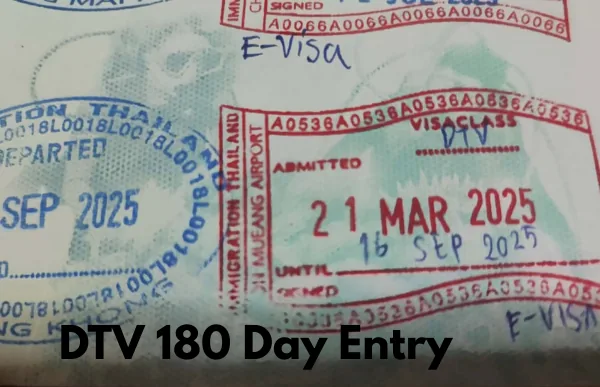
Critical distinction: The DTV visa is valid for 5 years, but your permission to stay in Thailand (called "stamp" or "entry permit") is granted in 180-day blocks. When your 180 days expire, your permission expires. Your visa does not. You must either extend your stay in-country or exit and re-enter to activate a fresh 180-day period.
Option A: In-Country Extension (180 days to 360 days)
You can extend your initial 180-day stay for an additional 180 days without leaving Thailand. This is the most common path for DTV holders planning to stay 10+ months continuously.
Process & Timing
- Visit Chiang Mai Immigration (Promenada, 239 Huay Kaew Road) between day 150 and day 180 of your initial stay
- Apply at least 30 days before your current permission expires (day 150 is safe)
- Wait 2-3 business days for processing (can sometimes be same-day with early arrival)
- Pay 1,900 THB (extension fee, non-refundable)
- Receive new TM.8 form and updated passport stamp showing new expiration date (day 360 from original entry)
Required Documents for Extension
- Passport (original)
- TM.7 form (provided by immigration, or print from their website)
- One 4x6 cm photo (white background, passport style)
- Proof of funds (500,000 THB bank statement, same account used for original application)
Some officers request updated employment contract or program letter if circumstances changed. Bring copies just in case. Better to have and not need than to be sent away to fetch documents.
Chiang Mai Extension Reality
Chiang Mai Immigration processes extensions between 08:00-11:30 weekdays only. Arrive by 10:00 to avoid being told to come back tomorrow. There is no online booking system (as of 2026). Bring a book; wait times are 45 minutes to 2 hours.
The office is closed Thai public holidays and sometimes closes for internal meetings without notice. Check their Facebook page (Chiang Mai Immigration) the day before. Rejection rate for extensions is very low (under 2%) because immigration already vetted you on initial entry.
Guru Tip: After your extension is stamped, immediately request a duplicate passport page copy. Keep this in a separate folder. If your passport is lost or stolen after extension, you have proof of your legal status while waiting for emergency travel document.
Option B: Border Hop (reset to new 180 days, free of charge)
Instead of extending in-country, you can leave Thailand and re-enter. When you re-enter on your valid DTV visa, immigration grants a fresh 180-day permission to stay (TM.6 stamp) at the border. This is free and gives you another full 180 days. Many DTV holders use this strategy to avoid the immigration office entirely.
Process: The Border Hop Timeline
- Book flight/transport 5-7 days before day 180 (your current permission expires)
- Depart Thailand before midnight on day 180
- Spend minimum 1 day outside Thailand (most DTV holders go to Da Nang, Vietnam, 30-45 minutes by flight, or Kuala Lumpur, Malaysia, 2 hours)
- Return to Thailand through any international port of entry (airports, land borders all work)
- At immigration desk, present passport and completed TM.6 card (provided on arrival)
- Receive new 180-day permission stamp, valid from re-entry date
Cost Breakdown: Border Hop vs Extension
Extension: 1,900 THB (immigration fee only). Border hop: 3,000-6,000 THB (flight or transport) + accommodation 500-2,000 THB (optional) = 3,500-8,000 THB. For most digital nomads, extension is cheaper. But border hops are common for those who want a travel break or prefer not dealing with immigration bureaucracy.
Chiang Mai Border Hop Reality
Chiang Mai International Airport (CNX) is Thailand's 4th busiest. Direct flights to Da Nang (Vietnam), Kuala Lumpur (Malaysia), and Bangkok (domestic) are frequent and cheap (500-3,000 THB one-way). The border hop is most popular route among Chiang Mai DTV holders, especially February (smoky season) and August (rainy season) when people want to escape.
When you return to Thailand, use the "foreigner" queue at immigration, not the "Thai nationals" queue. Hand the officer your passport and completed TM.6 arrival card. Processing is 2-5 minutes. You will receive a fresh 180-day stamp dated from that day forward.
Critical: Do not overstay. If your 180-day permission expires on July 15 and you return on July 16, you have overstayed 1 day. Overstay penalties are 500 THB per day plus blacklist risk. Always exit by day 180 at the latest.
Guru Tip: Mark your expiration date on a calendar (phone + physical). Add a 7-day alarm. Many DTV holders lose track of their dates juggling work, travel, and life. Immigration will not remind you. Overstay is on you.
4. Common Rejection Reasons in 2026: What Immigration Actually Checks
DTV approval rates are approximately 87% globally, but Chiang Mai rates run 92% because the office sees repeat applications and knows legitimate documentation. Rejections fall into five categories. Know these before applying.
1. Unverifiable or "Flash" Funds
You have 500,000 THB but the bank statement shows a deposit on day 89 of your 90-day window. Immigration rejects this because the seasoning is incomplete. The deposit appears sudden and unsourced. Real scenario: An applicant had 300,000 THB. His mother gifted him 200,000 on day 88. When he applied, immigration rejected him and told him to reapply 90 days later (from the gift date). He had to wait 4 additional months.
2. Employment Cannot Be Verified
You provided an employment contract from "TechCorp Inc." but immigration cannot find "TechCorp Inc." in any business registry (Companies House, US Secretary of State, etc.). They assume the company is fake and reject the application. Happened to 12% of rejections in 2025. Verify your company exists in a public registry before submitting the contract. Use Companies House (UK), Secretary of State (US), or ABN Lookup (Australia) to double-check.
3. TM.30 (Residential Address Reporting) Mismatch
You applied for DTV claiming residence in Bangkok, but filed your TM.30 from a Chiang Mai address. Immigration flags this as inconsistent information and rejects the application. TM.30 is Thailand's residential address registration. Your stated residence on the DTV application must match your TM.30 filing address. If you move, update your TM.30 first, then reapply for DTV.
This is a significant 2026 issue because immigration now cross-references TM.30 databases with DTV applications in real-time (previously manual, now automated).
4. Soft Power Program Letter is Outdated or Unverifiable
You provided a program letter from a Muay Thai gym dated 2 months ago (stale documentation). Immigration rejects it because it falls outside the 30-day window. Or, the gym listed on the letter does not appear in Ministry of Education records. Immigration calls the gym to verify and discovers the school is not registered. Automatic rejection.
Always use a school or gym that is registered with Thailand's Ministry of Education. Get a fresh program letter dated within 30 days of your application.
5. Incomplete or Inconsistent Documentation
Your employment contract says your name is "David Smith" but your passport shows "David John Smith." Immigration flags this as a potential name mismatch and requests clarification. Delays approval by 3-5 weeks, sometimes results in rejection if you cannot explain the discrepancy. Use the exact name on your passport everywhere: contract, invoices, bank statements, all documents.
DTV Frequently Asked Questions
No. The DTV is explicitly for remote work with non-Thai entities only. You cannot start a Thai business or work for a Thai employer on a DTV. If you work for a Thai company (even if based abroad), immigration considers this Thai employment and rejects the visa. To start a Thai company or work for Thai employer, you need a Non-B (Work Permit) visa, which requires the company to sponsor you and prove no Thai nationals can do the job. DTV and Non-B are separate visa categories.
Yes. TDAC is mandatory for every single arrival at a Thai port of entry, regardless of visa type or how many times you have entered previously. Fill it online at tdac.immigration.go.th within 3 days before arrival. You'll receive a QR code via email. Scan this QR code at immigration on arrival. If you forget the TDAC, you can fill one on paper at the airport, but this adds 10-15 minutes to your arrival process. Most DTV holders fill the TDAC on the flight, 3-4 hours before landing.
Technically, you only must show 500,000 THB during two moments: (1) initial DTV application and (2) when applying for the 180-day in-country extension. After the extension is approved, you can withdraw the money if you choose. However, this is high-risk. Immigration sometimes conducts random financial audits on DTV holders, especially if your work profile changes or you apply for related benefits (like a Thai bank loan using your DTV as proof of residency). Keep the balance liquid and available in case of a spot check. Many DTV holders maintain the 500k as a safety net.
Minimum age is 20 years old. No maximum age. You must be at least 20 to apply as a primary DTV holder. If you are under 20, you can qualify as a dependent (child) on a parent's DTV. There is no upper age limit, so a 75-year-old can apply. However, some embassies request medical certification for applicants over 70, though this is not official policy.
You must be outside Thailand to apply. DTV applications are processed through the official Thai e-Visa portal, which is only accessible to applicants physically outside Thailand, and generally only from your own country of citizenship or residence. If you are currently inside Thailand on a tourist visa or other permit, you must exit first, then apply from outside. Once approved, return to Thailand and present your DTV at the immigration desk on arrival. You cannot apply for a DTV while inside Thailand.
Your 180-day permission is tied to your physical presence in Thailand. If you are overseas and your expiration date passes, your permission remains expired while you are away. However, the moment you try to re-enter Thailand, immigration will flag the expired permission and deny entry. You'll be sent back to your origin country. Before you travel outside Thailand, ensure you have either (1) extended your stay to cover your travel dates, or (2) plan to return before day 180. Check your expiration date 7 days before international travel.
Summary: DTV in 2026 Requires Deliberate Preparation
The DTV is a 5-year visa with genuine strategic value for remote workers and digital nomads. Approval rates in Chiang Mai are 92% because the office sees quality documentation. But approval is never guaranteed. Rejections happen to applicants who underestimate the scrutiny: "flash balance" funds, unverifiable employment, incomplete program letters, or documentation inconsistencies.
Your competitive edge is preparation. Start your 90-day seasoning 4+ months before you plan to apply. Verify your employer exists in a public business registry. If using Soft Power, enrol with a school registered with Thailand's Ministry of Education. Gather documentation. Cross-check your name spelling everywhere. Ask for verification letters from your bank and employer before submitting.
The DTV opens 5 years of legal, penalty-free residence in Thailand. That alone is worth the 3-4 weeks of preparation and the 1,900 THB fee. Apply with evidence, not hope.
Ready to Apply or Need Help?
CMLocals offers DTV document reviews and pre-application audits. We verify your employment contract against business registries, check your financial seasoning timeline, and flag any inconsistencies before you submit. A single rejection costs 8+ weeks of waiting and stress. Get it right the first time.
Last verified: August 2026. Immigration policies and fees change. Verify current requirements directly with Chiang Mai Immigration (Promenada office) or the official Thai e-Visa portal before applying.