
2026 update: All DTV e-Visa applications now require two additional documents: proof of citizenship or permanent residence in the country of application, and a police clearance certificate issued within the last six months. This closes the practice of applying through a convenient third-country embassy, since applicants generally now need to apply from their home country or country of legal residence. Confirmed by the Royal Thai Embassy, London, and consistent with notices from Vientiane and Dhaka. Requirements may vary by immigration office and embassy, so confirm directly with the embassy or consulate where you intend to apply before submitting.
Who This Visa Is For
DTV Thailand is the common shorthand for the Destination Thailand Visa, the long-stay visa this guide covers in full. The Destination Thailand Visa (DTV) was introduced by the Thai government in mid-2024. It targets a specific type of visitor: people who want to spend extended periods in Thailand without seeking local employment. The primary audience is remote workers, freelancers, and digital professionals who earn income from outside Thailand and want to spend months at a time working from places like Chiang Mai.
The DTV also covers participants in certain short-term programmes . for example, Muay Thai training camps, Thai language courses, cooking schools, wellness retreats, and similar activities. This broader eligibility makes it flexible for those who combine leisure, learning, and remote work during a long stay. For formal education programs where you want to study full-time, the ED visa may be a better fit.
It is not suited to people who want to work for a Thai employer, run a local business, or live in Thailand indefinitely without periodic re-entry. For those situations, see the full overview of Thai visa options on CMLocals, which covers long-stay alternatives including the ED visa, LTR, and retirement visas.
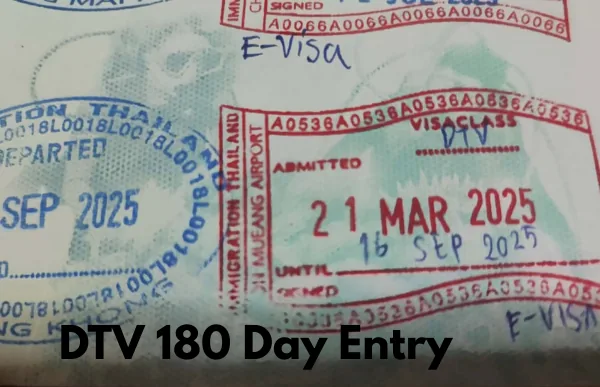
Official Classification
The DTV is a special category visa issued by the Royal Thai Embassy or Consulate in the applicant's home country, or through Thailand's official e-Visa portal. It is not an extension of the tourist visa system. It carries its own classification with specific eligibility criteria, stay conditions, and extension rules that differ from the standard tourist (TR) visa or visa-exempt entry.
Applicants apply before entering Thailand. The DTV cannot be obtained at a land border or airport on arrival.
Validity and Extensions
The DTV is issued with a five-year validity from the date of issue. During those five years, the holder can enter and exit Thailand multiple times.
Each entry grants an initial permitted stay of 180 days. If the holder wishes to remain in Thailand beyond that initial period, a single in-country extension of up to 180 days can be applied for at a Thai Immigration office. In practice, this means a DTV holder can potentially remain in Thailand for around 360 days on a single entry before needing to depart and re-enter.
| Feature | Detail |
|---|---|
| Visa validity | 5 years from issue date |
| Entry type | Multiple entry |
| Stay per entry | 180 days |
| In-country extension | Up to 180 additional days |
| Maximum stay per entry (with extension) | Approximately 360 days |
| Where extension is done | Immigration office (e.g., Chiang Mai Immigration) or via e-Extension where available |
After departing, the holder can re-enter and begin a new 180-day permitted stay, provided the visa remains valid. The five-year visa validity does not reset.
Financial Requirements
Applicants must demonstrate financial sufficiency at the time of application. The standard requirement is proof of funds of at least 500,000 Thai baht (approximately 13,500-14,500 USD, depending on current exchange rates) held in a personal bank account.
This must typically be evidenced by bank statements showing the funds have been present for a reasonable period . not deposited just before applying. Obtain information about specific requirements from the Thai embassy or consulate website for your jurisdiction, then submit your application through the eVisa system at https://www.thaievisa.go.th/.
| Requirement | Amount / Condition |
|---|---|
| Minimum funds | 500,000 THB (approx. equivalent in foreign currency) |
| Evidence format | Bank statement . typically 3-6 months of statements |
| Health insurance | Required. Minimum 40,000 THB outpatient and 400,000 THB inpatient coverage per policy year |
| Income proof | May be required to demonstrate ongoing remote income (e.g., freelance contracts, employment letter from foreign employer) |
| Dependents | Each dependent (spouse or child under 20) adds an additional 500,000 THB equivalent to the household total, plus a separate application fee per dependent |
Health insurance is a firm requirement, not optional. Many standard travel insurance policies do not meet the minimum inpatient coverage threshold. Confirm your policy meets Thai immigration criteria before applying.
Funds that were deposited shortly before applying are a common rejection cause. Multiple embassies, particularly Vientiane, expect the balance to have been held (or "seasoned") for at least three months before submission, and may cross-check this against your statement history rather than a single balance screenshot. Some embassies also state the threshold in local currency rather than a floating THB conversion, for example the Royal Thai Embassy, London, lists it as a fixed £11,000.
Required Documents
The exact document list depends on the issuing embassy or consulate. The following documents are commonly required across most applications:
- Valid passport with at least 18 months remaining validity
- Completed DTV visa application form
- Passport-size photograph (meeting Thai visa photo specifications)
- Proof of funds: bank statements covering at least the past three to six months
- Proof of qualifying activity: employment letter (for remote workers), freelance contracts, or confirmation of enrolment in a qualifying programme (Muay Thai, cooking school, language course, etc.)
- Health insurance certificate meeting the 40,000 / 400,000 THB coverage thresholds
- Return or onward travel booking (some embassies require this; others do not)
- Accommodation details in Thailand (initial address)
- Proof of citizenship or permanent residence in the country where you are applying (now required nationwide)
- Police clearance certificate (certificate of no criminal record), issued within six months of submission, with a certified English translation if not already in English (now required nationwide; dependents under 16 may submit the primary DTV holder's certificate instead of obtaining their own, per Royal Thai Embassy, London guidance)
All DTV applications go through the eVisa system at https://www.thaievisa.go.th/ as of January 2025. Requirements may vary slightly depending on your jurisdiction, so check the Thai embassy or consulate website for your location before submitting your application. The embassy or consulate that reviews your file is determined by your country and, in larger countries, your state or region of residence, see the application process section below for how jurisdiction is assigned.
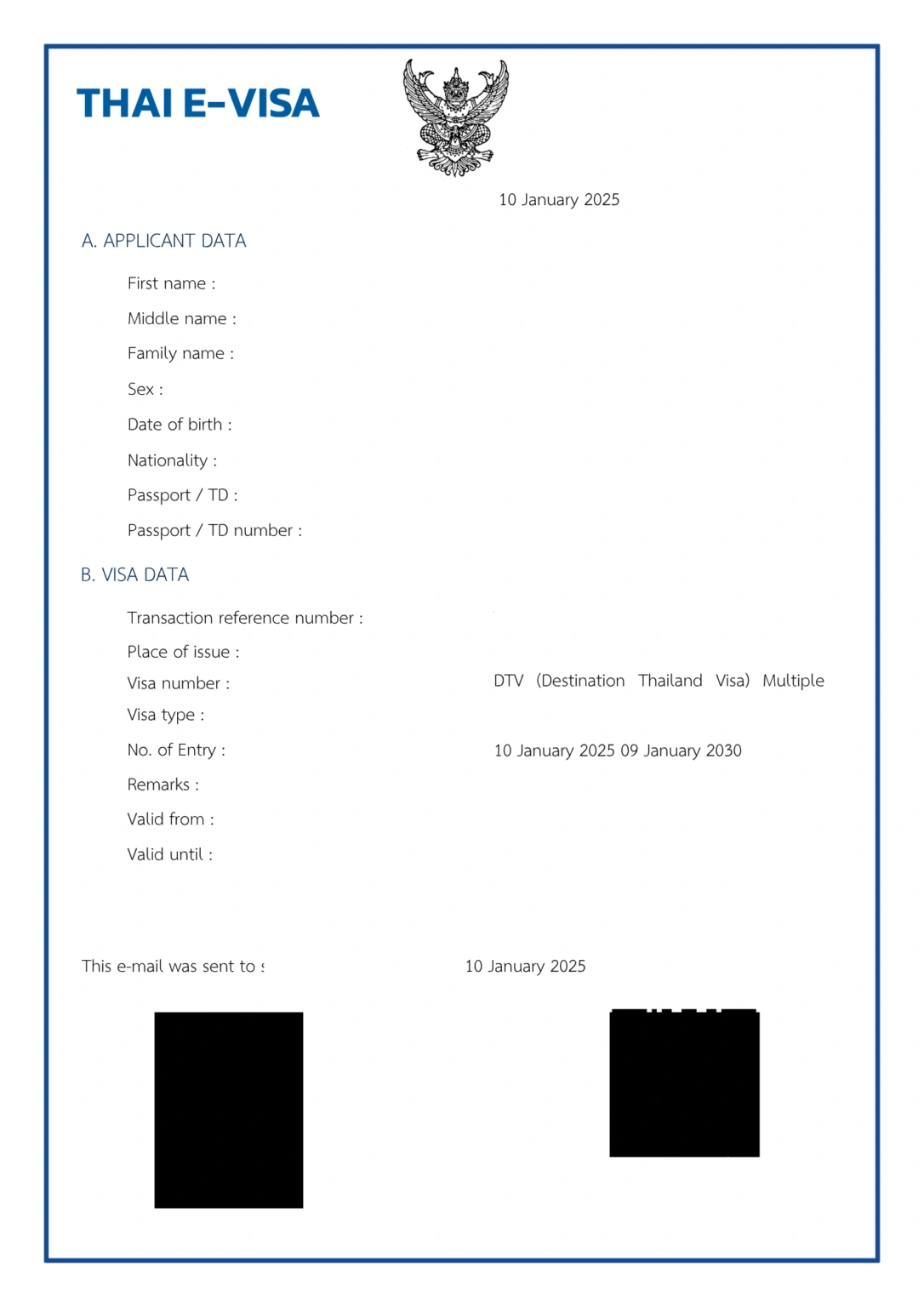
Application Process
Applying from outside Thailand
- Identify the Thai embassy or consulate with jurisdiction over your location, or check eligibility for the Thai e-Visa portal (evisa.thaigov.go.th).
- Gather all required documents. Pay particular attention to the health insurance and bank statement requirements.
- Submit the application . in person, by post (where permitted), or online via the e-Visa system.
- Pay the application fee. Fee amounts vary by issuing location.
- Wait for processing. Times vary by embassy; allow at least five to ten working days. Some locations process faster.
- Receive the DTV stamp or sticker in your passport. Verify the start date, entry type, and validity period before leaving the embassy.
Extending your stay inside Thailand
- Visit the local Immigration office before your current 180-day permitted stay expires. For Chiang Mai residents, this is Chiang Mai Immigration Office.
- Bring required documents: passport, TM.7 extension form, evidence of address (TM.30 if applicable), and any supporting documents the office requests.
- Pay the extension fee (typically around 1,900 THB, though fees can change . verify with Immigration).
- Receive a stamp indicating the new permitted stay end date. Do not remain in Thailand beyond this date.
For general guidance on how the Chiang Mai office processes extensions and what to expect locally, see the Chiang Mai Immigration guide on CMLocals.
Where to Apply: Country-by-Country Difficulty (2026)
Since the citizenship/residence requirement took effect, applicants generally need to apply from their home country or a country where they hold permanent residence, not from any embassy of convenience. The comparison below is included for context on how processing differs by location and for anyone who is legitimately eligible to apply outside their home country. It reflects publicly reported outcomes and community experience at the time of writing, not official Thai government ranking of these offices.
Course duration expectations have moved up through 2026. Early guidance cited six months as a safe minimum for Soft Power programmes such as Muay Thai or cooking courses; more recent reports put nine months as the figure embassies increasingly expect, with the trend continuing upward. Short two-to-four-week courses are now reported to carry a near-total rejection rate. Confirm the specific consulate's current expectation before booking a course, this is one of the fastest-moving figures in the whole system.
Vietnam
Royal Thai Embassy, Hanoi (northern region) · Royal Thai Consulate-General, Ho Chi Minh City (southern region)
Pros: the most balanced and consistent processing in the region; still accepting one-month courses in some cases, though a longer course strengthens the file; visa-exempt entry for many nationalities makes it straightforward to fly in and apply.
Cons: Ho Chi Minh City verifies enrollment directly with the gym or school, so documentation must be genuine; applicants generally need to be physically present in the correct region (north for Hanoi, south for HCMC) and may need to prove it; a strict officer on a given day is still possible.
Laos
Royal Thai Embassy, Vientiane · Royal Thai Consulate-General, Savannakhet
Pros: close and inexpensive to reach from Thailand for a short application trip; Vientiane has a track record of consistent outcomes; high application volume means officers are experienced with the process.
Cons: strict enforcement of the 500,000 THB funds-seasoning rule, expect funds to need three or more months in the account; an in-person interview is required and can include a spot-check of your banking app; Savannakhet is less predictable and generally not worth the detour.
Cambodia
Royal Thai Embassy, Phnom Penh
Pros: convenient if you are already in the region; standard requirements on paper, with no officially stated year-long course requirement; historically a reliable backup to Laos and Vietnam.
Cons: currently complicated by Thailand-Cambodia political tension; Muay Thai applications specifically may face extra sports-authority certification demands; slower processing than Vietnam or Laos.
Indonesia
Royal Thai Embassy, Jakarta
Pros: historically approved six-month courses without demanding a full year; an established option many applicants have used successfully; workable if your finances are strong.
Cons: has become noticeably stricter through 2026; now effectively expects six or more months of course commitment; requires real proof of engagement, such as photos and event attendance, not token enrollment.
Malaysia
Royal Thai Embassy, Kuala Lumpur · Royal Thai Consulate-General, Penang
Pros: convenient location within the region; was previously considered fast and accessible.
Cons: increasingly difficult through 2026; now requesting extra sports-authority documents that can take 30 to 45 days to obtain; most current applicants are actively avoiding it as inefficient. The Royal Thai Consulate-General, Penang, specifically requires physical presence in Malaysia at the time of e-Visa submission (with your MDAC arrival stamp and previous country's exit stamp uploaded), a full three-month consecutive bank statement history showing account holder name, account number, balance, and daily transactions, and standard processing of five to seven working days once the file is complete.
Philippines
Royal Thai Embassy, Manila
Pros: an emerging option with a relatively straightforward process; no clearly stated minimum course duration; most current applicants are succeeding with three to six month packages.
Cons: less established, so less community data to rely on; possibility of being called in for an interview; untested at scale compared with Vietnam or Laos.
Singapore
Royal Thai Embassy, Singapore
Pros: clear, structured, and fair once you are eligible; rules do not shift unpredictably and officers are professional and consistent.
Cons: generally requires existing long-term residency there; not viable as a tourist applicant; limited usefulness for most people comparing embassies.
United States, United Kingdom, and other Western embassies
Royal Thai Embassy, London · Royal Thai Embassy, Washington D.C.
Pros: convenient if you are already resident there and want to apply before departure; no need to travel to Southeast Asia first.
Cons: consistently the slowest processing, often 10 to 20-plus business days versus 3 to 7 in Southeast Asia; reported to scrutinise applications more closely overall; a higher application fee, for example around 400 USD in the United States versus roughly 280 USD (10,000 THB) at most Southeast Asian posts.
Applying from the United States: the e-Visa portal routes your application by jurisdiction, not free choice. Royal Thai Embassy, Washington D.C., covers the southeast and mid-Atlantic states and Texas; Royal Thai Consulate-General, Los Angeles, covers the west coast and mountain states plus Pacific territories; Royal Thai Consulate-General, New York, covers the northeast and parts of the midwest; Royal Thai Consulate-General, Chicago, covers the remaining midwest states. Applying through the wrong office's jurisdiction for your state of residence can cause delays or a technical rejection unrelated to the substance of your application. Confirm your assigned jurisdiction with the relevant Royal Thai Embassy or Consulate-General before starting the e-Visa submission.
Regardless of which embassy or consulate reviews your file, every DTV application is submitted through the single official Thai e-Visa portal at thaievisa.go.th. Embassy and consulate websites identify who reviews your application based on jurisdiction, they are not a separate place to apply.
Chiang Mai Application Notes
The DTV itself is applied for abroad, not in Chiang Mai. However, Chiang Mai Immigration handles in-country extensions and ongoing compliance requirements for DTV holders based in the city.
Chiang Mai Immigration is located at 71 Mahidol Road, Chiang Mai. It handles 90-day reporting, extensions of stay, address registration confirmations, and re-entry permit issuance.
Processing at Chiang Mai Immigration can sometimes differ from procedures published nationally. Queue lengths and document interpretation can vary. Arriving early in the morning and bringing additional copies of all documents is advisable. For the most current local guidance, visit the Chiang Mai Immigration guide.
The Thai e-Extension portal (immigration.go.th) handles some extension applications online, which can reduce the need to visit in person. Availability of online extensions for DTV holders should be verified at the time of application as the portal's scope of covered visa types changes periodically.
Ongoing Compliance Requirements
90-day reporting
Any foreigner who stays in Thailand continuously for 90 days must notify Immigration of their current address. This is a reporting obligation, not an extension . it does not affect your permitted stay end date. See the Immigration compliance section on CMLocals for full details on the 90-day reporting process.
TM.30 address registration
The TM.30 form requires that your host (landlord, hotel, or guesthouse) notify Immigration of your address within 24 hours of your arrival. In practice, most hotels manage this automatically. If renting long-term, confirm your landlord submits the TM.30. Failure to have a current TM.30 on file can cause complications when extending your stay or submitting a 90-day report.
Re-entry permits
The DTV is a multiple-entry visa, so no re-entry permit is required for temporary departures during the five-year validity period. Each return to Thailand begins a new 180-day permitted stay, provided the visa has not expired.
If you have received an in-country extension and wish to leave and return before that extension period ends, confirm the re-entry rules with Immigration before departing . exiting Thailand can in some circumstances cancel an active extension of stay.
Pros and Cons for Chiang Mai
Why the DTV works well for Chiang Mai
- Chiang Mai is well suited to the DTV's target profile: low cost of living, reliable co-working infrastructure, strong digital connectivity, and a large community of long-term foreign residents.
- The 180-day initial stay and 180-day extension allow residents to spend most of a year without leaving . a realistic arrangement for remote workers who want to base in Chiang Mai without committing to a full retirement or investment visa.
- The DTV's qualifying activities (Muay Thai, language study, cooking) align directly with options available in Chiang Mai. Many DTV holders enrol in part-time programmes alongside remote work.
- Chiang Mai Immigration handles extensions for DTV holders, and the process is generally manageable with adequate preparation.
Limitations to consider
- The 500,000 THB funds requirement is a genuine threshold . not everyone who wants to live and work remotely in Chiang Mai will meet it comfortably on paper.
- The DTV does not permit local employment. This matters for people who eventually want to consult locally, teach English, or work with Thai entities in any capacity.
- Tax residency rules apply independently of visa status. Staying in Thailand more than 180 days in a tax year may create Thai personal income tax obligations, including on certain foreign-sourced income. This is a separate issue from the visa and requires professional tax advice if relevant to your situation.
- The visa must be renewed every five years, requiring a new application from abroad.
- Thai language schools no longer qualify as a Soft Power activity for the DTV. Applicants wanting to study Thai are directed to the Non-Immigrant ED visa or ED Plus visa instead. Muay Thai training and Thai culinary courses remain the two clearest qualifying examples.
- Enforcement now extends well past the approval stage. Immigration officers have been reported contacting schools and gyms directly to confirm a DTV holder is genuinely enrolled and that the training package was actually purchased, sometimes years into the five-year validity. Holders are advised to keep supporting documentation for the life of the visa, not just at the point of application, whether the DTV was based on Muay Thai, a cooking course, or workcation-style remote employment.
What airport and immigration checks look like in practice
Community reports describe a consistent pattern at Bangkok airport immigration in 2026: officers questioning DTV holders about whether they are still actively training, asking for the exact dates and hours of their course, and expecting a level of ongoing engagement that goes beyond the original enrolment paperwork. One applicant reported being held for roughly two and a half hours on a re-entry, questioned on video about their Muay Thai training hours, other activities during the week, and how their stated purpose lined up with their actual routine in Chiang Mai. Their school's cooperation was reportedly a significant factor in resolving the check.
The consistent theme across these reports is that your stated purpose, your actual location, and your ongoing activity all need to line up. A Muay Thai enrolment in one city while actually living and training in another is exactly the kind of mismatch that invites extended questioning. Use a real, local training provider that matches your actual city of residence, and keep attendance evidence current, not just a one-time enrolment letter.
A realistic example
A 34-year-old UX designer working remotely for a European agency decides to spend eight months in Chiang Mai. She applies for a DTV at a Thai embassy in her home country, provides her employment contract and 500,000 THB equivalent in savings, and obtains qualifying health insurance. She enters Thailand, stays 180 days, then visits Chiang Mai Immigration for a 180-day extension. She manages 90-day reporting online. After eight months she departs, and can re-enter later in the five-year validity period.
Common Pitfalls and Misunderstandings
The DTV does not authorise local employment in Thailand. Working for a Thai company or client, running a local business, or receiving Thai-sourced income requires a separate work permit and appropriate non-immigrant visa. The DTV does not cover this.
- Assuming remote work is fully authorised. The Thai government has indicated the DTV supports remote workers, but formal work permit regulations for foreign nationals have not been comprehensively rewritten. Enforcement patterns are not something CMLocals speculates on, but holders should be aware the legal framework for remote work in Thailand remains a grey area. Seek qualified legal advice if this matters to your situation.
- Underestimating the health insurance requirement. The 40,000 / 400,000 THB coverage thresholds exclude many budget travel policies. Verify your policy's Thai baht equivalent before applying.
- Confusing the DTV with the visa-exempt entry or tourist visa. The DTV is a different document with different rules. Do not treat it as an extended tourist visa or assume tourist visa rules apply.
- Exiting Thailand while an extension is active. Departing Thailand can invalidate an in-country extension of stay in some circumstances. Confirm the rules with Immigration before booking any travel during an extension period.
- Overstaying. Remaining in Thailand beyond the permitted stay date stamped in your passport carries significant penalties, including fines, deportation, and bans on re-entry. See the Immigration compliance section for details on overstay consequences in Thailand.
- Assuming Chiang Mai and Bangkok Immigration interpret rules identically. Local offices sometimes apply requirements differently. Document requirements for extensions and 90-day reports can vary slightly. Requirements may vary by immigration office.
Related Visa Options to Consider
If the DTV does not suit your situation, the following alternatives are often compared with it:
Frequently Asked Questions
The DTV is open to most foreign nationals who meet the eligibility criteria: proof of at least 500,000 THB in funds, qualifying health insurance, and a qualifying purpose of stay. Qualifying purposes include remote work or freelancing for foreign entities, and participation in programmes such as Muay Thai, Thai language study, cooking courses, meditation retreats, and similar activities.
Citizens of countries subject to Thai embassy-specific restrictions should confirm eligibility at their local Thai embassy or consulate. Requirements may vary by issuing location.
Each entry grants an initial 180-day permitted stay. You can apply for one in-country extension of up to 180 additional days at a Thai Immigration office before your first 180 days expire. This allows a continuous stay of up to approximately 360 days per entry.
The DTV has a five-year validity and is multiple-entry, so after departing you can re-enter and begin a new 180-day period, as long as the visa has not expired.
The DTV does not include a Thai work permit. Working for a Thai employer or performing services for Thai clients for Thai-sourced income requires a work permit and a non-immigrant B visa. The DTV does not cover this.
Remote work for a foreign employer or foreign clients . where all income is sourced outside Thailand . occupies a grey area. The Thai government introduced the DTV partly to accommodate this group, but formal work permit regulations have not been updated to explicitly authorise this arrangement. Seek qualified legal advice if local work or tax liability is relevant to your situation.
No. The DTV must be applied for through the eVisa system at https://www.thaievisa.go.th/ before entering Thailand. It cannot be converted to from another visa status inside Thailand, and it is not available at airports or land borders on arrival.
If you are already in Thailand on a tourist visa or visa exemption, you would need to depart and apply through the eVisa system. Obtain information about requirements from the Thai embassy or consulate website for your jurisdiction.
Visit Chiang Mai Immigration (71 Mahidol Road) before your current permitted stay expires. Bring your passport, a completed TM.7 extension application form, current address documentation, and the extension fee (typically around 1,900 THB . verify current fees at the office). Arriving early in the morning reduces waiting time significantly.
The Thai e-Extension portal may offer online extension options for certain visa types. Check whether DTV extensions are available online at the time of your application, as the portal's scope changes. For practical local guidance, see the Chiang Mai Immigration guide.
Your visa status and your tax residency status are separate matters. Staying in Thailand more than 180 days in a calendar year may make you a Thai tax resident for that year. Thai tax residency can create obligations related to personal income tax, including on certain categories of foreign-sourced income remitted to Thailand, depending on when that income was earned.
This is an evolving area of Thai tax law, and the rules around foreign-sourced income have been updated in recent years. Seek professional tax advice if you are approaching 180 days of stay per year. CMLocals does not provide tax advice.
Processing times vary by issuing embassy and country. A typical range is five to fifteen working days, though some embassies process applications faster. The e-Visa portal processing may differ from in-person embassy processing.
Visa fees vary by issuing location and are set by the Thai embassy or consulate. CMLocals does not publish specific fee figures as these change periodically. Confirm the current fee with the embassy or consulate where you apply before submitting your application.
Disclaimer - General Thai Visa Advice Only
CMLocals is a dedicated DTV Thailand information resource, covering eligibility, financial requirements, the application process, and extensions for the Destination Thailand Visa in the depth this page provides.
The information on this page is general in nature. It cannot replace personalised legal, immigration, or tax advice from a qualified professional. Thai immigration rules, embassy procedures, and officer discretion change frequently and without notice. Individual embassy requirements, approval patterns, and enforcement practices vary and are subject to the sole discretion of Thai immigration officers and Royal Thai Embassy or Consulate staff.
Always verify current requirements directly with the official Thai e-Visa portal (thaievisa.go.th) or the Thai embassy or consulate where you intend to apply, before making travel, financial, or visa decisions. CMLocals accepts no liability for visa rejections, denied entry, or any consequences arising from reliance on this content.
Last reviewed: August 2026